LocationDept. of CS & IE, Big Data Lab, Asia University, Wufeng, Taichung, Taiwan 41354
Basic Information
I am a graduate researcher and M.E. student at Asia University, Taiwan, pursuing a Master of Engineering in Computer Science and Information Engineering with a perfect GPA of 4.30/4.30. My research at the Big Data Lab is focused on robotics, dynamic path planning, and skeletonization-based algorithms for autonomous mobile robots.
I am a recipient of the Taiwan Ministry of Education (MOE) Scholarship 2024, awarded in recognition of academic excellence and research potential. Prior to graduate studies, I completed a B.Tech. in Electrical & Electronics Engineering at Lovely Professional University, India (GPA 8.18/10).
Education
M.E. — Computer Science & Information Engineering
Asia University, Taichung, Taiwan · 2024 – Present
GPA: 4.30 / 4.30 · MOE Scholarship 2024 · Big Data Lab
B.Tech — Electrical & Electronics Engineering
Lovely Professional University, Punjab, India · 2020 – 2024
GPA: 8.18 / 10
Research Area & Specialization
Dynamic Path Planning
Robot navigation in unknown environments using skeleton-guided Dial wave propagation (LL₀/LL₁/LL₂).
Real-time obstacle avoidance using Euclidean distance fields and connectivity-preserving topology.
Image Processing
Morphology, edge detection, thresholding applied to autonomous robotics and medical imaging.
NLP & Graph Theory
Network topology G(N,E) encoding for machine learning graph-based models.
Bioinformatics
Computational biology and data analysis applied to biological sequences and structural analysis.
Selected Publications
Md Hasibuzzaman, Gene Eu Jan, Han-Yan Wu, "Dynamic Path Planning in the Unknown Environment with Mobile Target and Obstacles," International Journal of Environmental Sciences, pp. 1510–1532, 2025. DOI
Md Hasibuzzaman, Gene Eu Jan, "Realization of Skeletonization Based on Wave Propagation with the Enhanced Grassfire and Path Planning Application," SSRN Preprint, 2025. DOI
Awards & Fellowships
Taiwan Ministry of Education (MOE) Scholarship
Ministry of Education, Republic of China (Taiwan) · 2024
Awarded to international students demonstrating exceptional academic merit. Covers full tuition and monthly living stipend for graduate study in Taiwan.
Perfect Academic Record — GPA 4.30 / 4.30
Asia University, Taiwan · 2024 – Present
Highest possible GPA maintained across all graduate coursework in the M.E. program.
"
Profile
Md Hasibuzzaman
I am a graduate researcher at Asia University, Taiwan, completing my M.E. in Computer Science and Information Engineering with a perfect GPA of 4.30/4.30. My research is conducted at the Big Data Lab and is focused on robotics, dynamic path planning, and computational geometry for autonomous mobile robots.
My core thesis investigates skeletonization via wave propagation for mobile robot navigation in unknown environments, developing novel collision-avoidance algorithms that integrate Euclidean distance transforms with topological medial-axis extraction using the four-stage EGF method.
I am a recipient of the Taiwan Ministry of Education (MOE) Scholarship 2024, granted in recognition of academic merit and research contribution. Prior to graduate studies, I completed a B.Tech. in Electrical & Electronics Engineering at Lovely Professional University, India (GPA 8.18/10, 2020–2024).
RoboticsPath PlanningImage ProcessingNLPGraph TheoryPythonC / C++R Language
Working at the intersection of robotics, computer vision, and artificial intelligence. My research develops mathematically rigorous algorithms for autonomous robot navigation — combining classical topology (EGF skeleton graphs) with modern wave-propagation path planning to solve real-world navigation challenges in cluttered, unknown environments.
Exp 1EGF Skeletonization — Wave-Propagation Based Morphological Skeleton
The Enhanced Grassfire (EGF) algorithm produces a clean, connected, 1-pixel-wide medial axis from any binary occupancy grid using four sequential stages:
Wave Propagation — Grassfire BFS assigns every free cell an arrival-time label equal to its shortest obstacle distance (EDT-like, 8-connected).
Fat Skeleton — Local maxima of the distance field are retained; cells whose removal disconnects the skeleton are preserved (topology-safe pruning).
1-Pixel Skeleton — Iterative parallel thinning reduces the fat skeleton to a single-pixel-wide medial axis without breaking connectivity.
Local Thinning (LUT) — A 3×3 look-up table removes redundant skeleton pixels while preserving branch endpoints and junctions, yielding a topologically correct Voronoi skeleton.
H-Blum Grassfire — Original Blum's symmetric axis transform via isotropic wave propagation.
EGF-MAT (Ours) — Enhanced Grassfire with 4-stage pipeline, measured on skeleton pixel count, branch count, connectivity, and computation time.
Test shapes include: circle, rectangle, L-shape, T-shape, cross, star, hand silhouette, ring, irregular polygon, composite maze, narrow corridor, and concave body. Results confirm EGF-MAT produces the thinnest, most connected skeleton with fewer spurious branches.
12 Test ShapesEDTH-BlumEGF-MATConnectivity
Exp 3Path Planning — 10-Algorithm Benchmark on EGF Skeleton Graph
An interactive path-planning system tests 10 algorithms on the same N×N occupancy grid, comparing skeleton-guided vs. classical planners:
#
Algorithm
Category
Heuristic / Cost
1
BFS
Classical
Uniform cost (uninformed)
2
Dijkstra
Classical
Exact shortest path, no heuristic
3
A*
Informed
f = g + h, h = octile distance
4
Greedy Best-First
Informed
f = h only (octile), not optimal
5
Bidirectional A*
Informed
Forward + backward A*, meet-in-middle
6
JPS (Jump Point Search)
Informed
A* with symmetry-breaking pruning
7
IDA*
Informed
Iterative deepening DFS with f-limit
8
Theta*
Any-angle
A* with line-of-sight shortcutting
9
Jan & Hasibuzzaman (Ours)
Skeleton-guided
EGF skeleton graph + Dial LL₀/LL₁/LL₂ wave
10
D* Lite
Dynamic
Replanning for changing environments
Metrics recorded: path length (cells), nodes expanded, computation time (ms). The EGF-skeleton-guided planner consistently reduces node expansions by channeling the search through the topological medial axis before local refinement.
The proposed Jan & Hasibuzzaman algorithm introduces a minimum-expansion moat strategy that drastically reduces the number of cells visited before a path is found:
EGF Skeleton Graph — The occupancy grid is skeletonized; the resulting 1-pixel medial axis becomes the search backbone.
Skeleton Path — A fast BFS/Dijkstra on the sparse skeleton graph finds a tentative skeleton-level route from source to target.
Moat Construction — A corridor (moat) of fixed width is dilated around the skeleton path to create a compact search region, discarding cells outside it.
Dial Wave (LL₀/LL₁/LL₂) — A 3-bucket circular Dial's algorithm propagates within the moat using fixed integer costs: straight = 100, diagonal = 141. Buckets cycle as (AT[n]/100) % 3. Only this final wave step is timed.
Method
Nodes Expanded
Path Cost
Time (ms)
A* (full grid)
High
Optimal
Baseline
Dijkstra (full grid)
Very High
Optimal
Baseline
Jan & Hasibuzzaman (moat only)
Minimal
Near-Optimal
Fastest
The moat restricts the Dial wave to a narrow band around the likely optimal path, achieving near-optimal path quality with a fraction of the node expansions compared to full-grid planners.
Republic of China (Taiwan) — International Graduate Student Award
🎓 Asia University
With President of Asia University
📍 Asia University, Taichung, Taiwan
📅 Meeting with University President — Academic Excellence Recognition
★ MOE Scholarship
MOE Scholarship Certificate Ceremony
📍 Taiwan Education Center, New Delhi, India
📅 2024 — Ministry of Education, R.O.C. (Taiwan)
Ministry of Education Scholarship Recipient
Md Hasibuzzaman was awarded the prestigious Taiwan Ministry of Education (MOE) Scholarship in 2024, recognizing outstanding academic performance and research contributions in Computer Science, Robotics, and Engineering.
This highly competitive scholarship is awarded by the Republic of China (Taiwan) to international students demonstrating exceptional academic merit and research potential at accredited universities in Taiwan.
Awarded by the Ministry of Education, Republic of China (Taiwan)
Certificate presented at the Taiwan Education Center, New Delhi, India
Recognition for M.E. studies at Asia University, Taichung, Taiwan
Reflects a perfect GPA of 4.30/4.30 in the graduate program
Covers full tuition and monthly living stipend for international study
One of Taiwan's most prestigious awards for international graduate researchers
Professional certifications, academic awards, and program recognitions
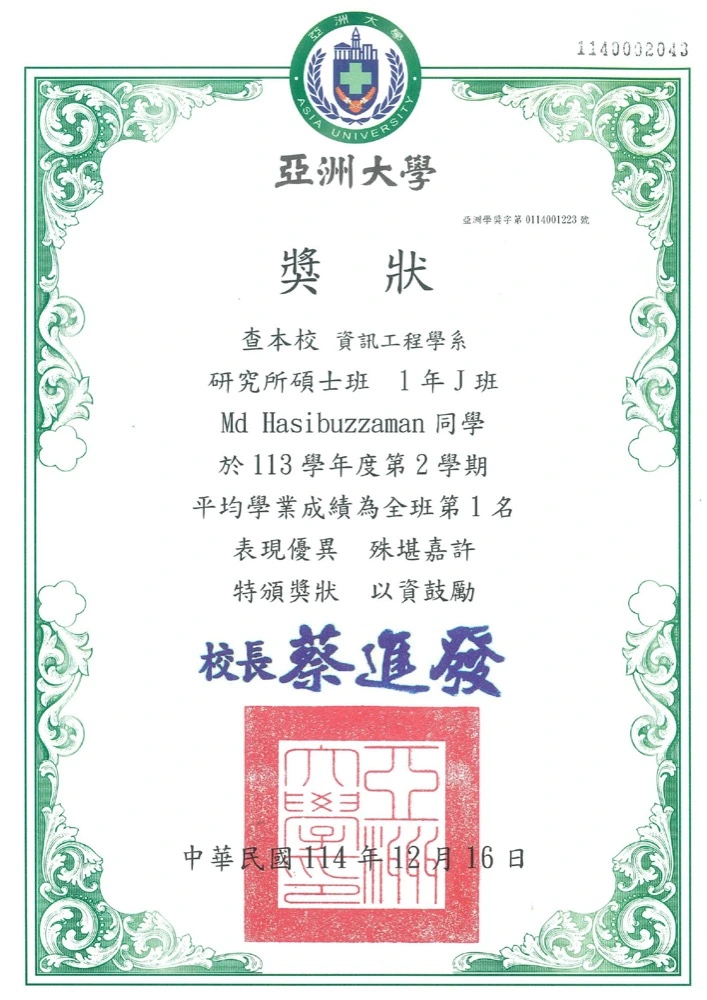
★ 1st in Class
Academic Excellence Award — 1st Place (2nd Semester)
Asia University (亞洲大學), Taiwan
December 16, 2025 · Certificate No. 0114001223
Awarded to Md Hasibuzzaman of the Department of Information Engineering (資訊工程學系), Master's Program (研究所碩士班), Year 1, Class J, for achieving the highest academic average in the entire class during the 113th Academic Year, 2nd Semester (113學年度第2學期). Recognized for outstanding performance and awarded with the highest commendation by Asia University President Tsai Jin-Fa (蔡進發).
Academic Excellence1st in ClassAsia UniversityAY113 Sem. 2
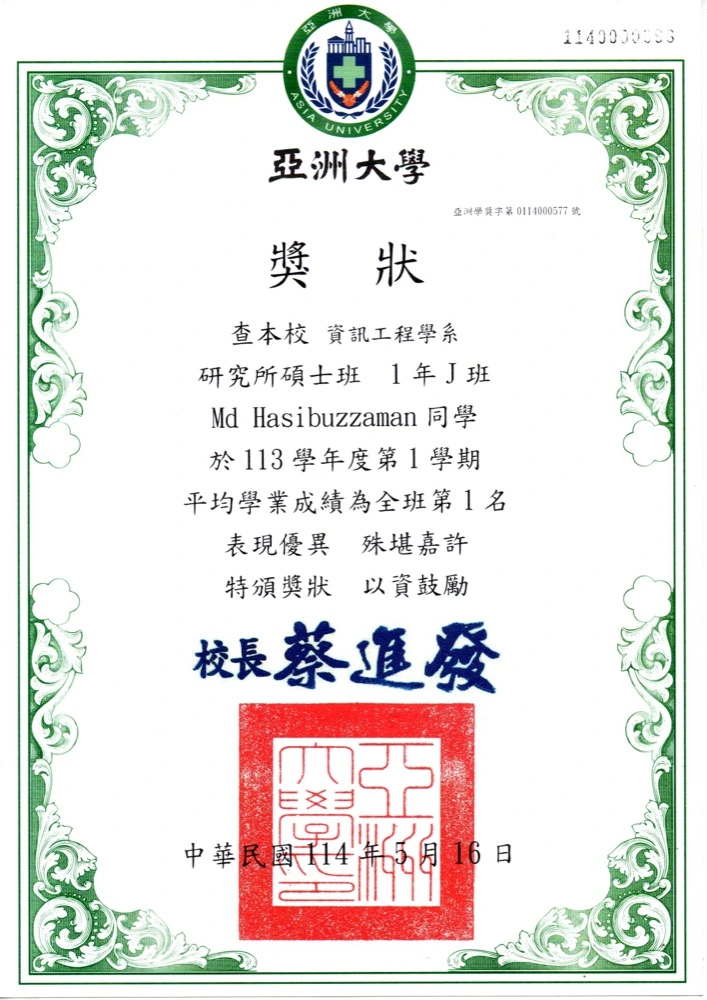
★ 1st in Class
Academic Excellence Award — 1st Place (1st Semester)
Asia University (亞洲大學), Taiwan
May 16, 2025 · Certificate No. 0114000577
Awarded to Md Hasibuzzaman of the Department of Information Engineering (資訊工程學系), Master's Program (研究所碩士班), Year 1, Class J, for achieving the highest academic average in the entire class during the 113th Academic Year, 1st Semester (113學年度第1學期). This honor reflects consistent academic dedication, culminating in a perfect GPA of 4.30/4.30 across both semesters.
Academic Excellence1st in ClassAsia UniversityAY113 Sem. 1
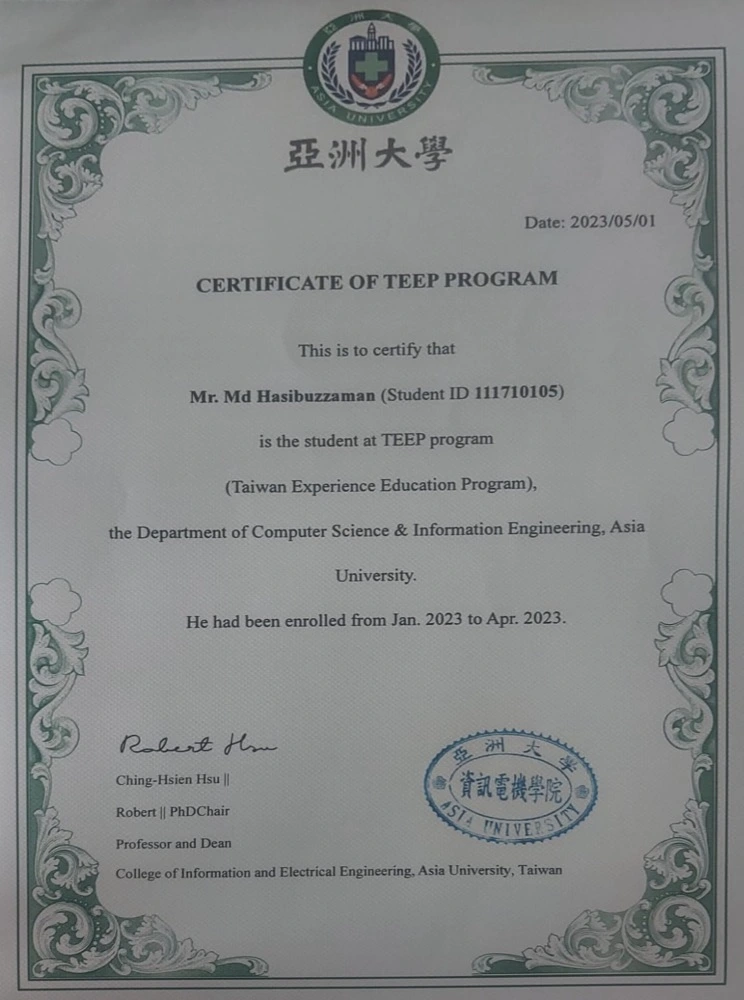
🎓 TEEP Program
Certificate of TEEP Program — Taiwan Experience Education Program
Asia University, Department of Computer Science & Information Engineering
May 1, 2023 · Student ID: 111710105
Certifies that Mr. Md Hasibuzzaman participated in the Taiwan Experience Education Program (TEEP) at the Department of Computer Science & Information Engineering, Asia University, Taiwan. Enrolled from January 2023 to April 2023. Signed by Professor and Dean Ching-Hsien Hsu (Robert), College of Information and Electrical Engineering. This program laid the foundation for subsequent admission into the graduate M.E. program.
TEEP ProgramAsia UniversityJan–Apr 2023Taiwan
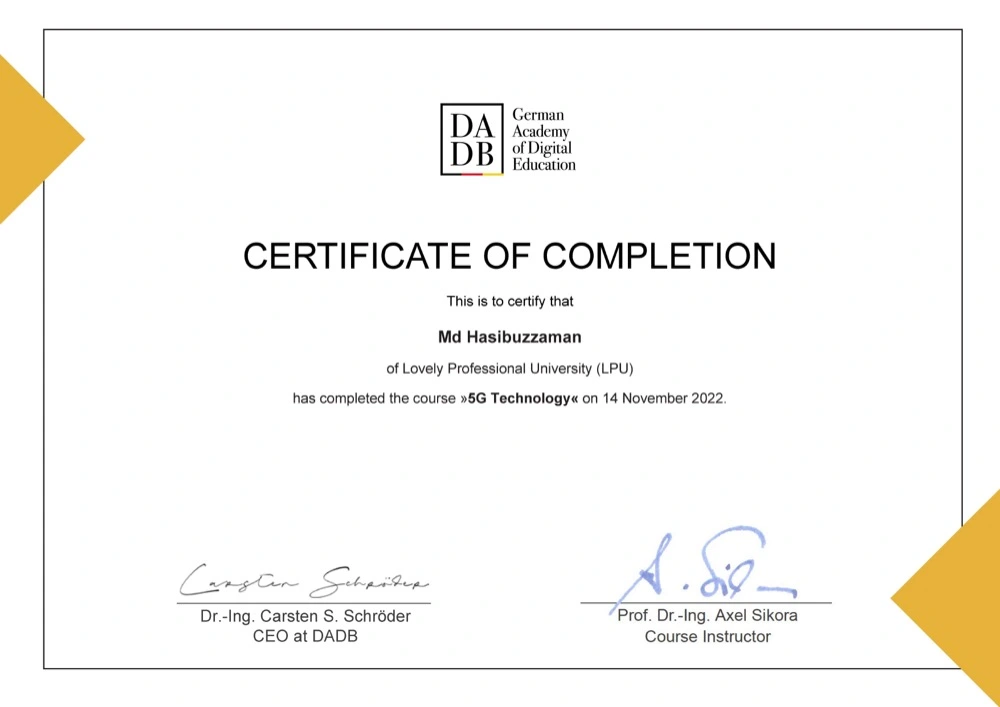
📡 5G Technology
Certificate of Completion — 5G Technology
German Academy of Digital Education (DADB), Germany
November 14, 2022
Certifies that Md Hasibuzzaman of Lovely Professional University (LPU), India, has successfully completed the course »5G Technology« offered by the German Academy of Digital Education (DADB). The course was instructed by Prof. Dr.-Ing. Axel Sikora and certified by Dr.-Ing. Carsten S. Schröder, CEO at DADB. This certification demonstrates expertise in next-generation wireless communication systems and 5G network architectures.
Input: Binary shape — free cells (sea area, S/L = 1) and obstacle cells (landmass, S/L = ∞) on an m × n raster map.
Step 1 — Topology-Preserving Medial Axis M
Extract the medial axis (skeleton) M of the free space using the Enhanced Grassfire (EGF) four-stage pipeline:
Step 1.1Perform object wave propagation from the contour lines of the obstacles and the border lines of the map. Each free cell Ci,j receives an arrival time ATi,j = distance to nearest obstacle, initialised with AT = ∞ and Vis = false.
Step 1.2Obtain the ridge vertices (fat skeleton) by the Common Vertices Method — cells where two or more distinct wavefront source IDs meet among the 4-connected neighbours.
Step 1.3Apply one-pixel skeletonization based on the 64-Pattern Skeleton Refinement — iterative directional and subfield thinning (connectivity number C(P) = 1) until a true 1-pixel-wide skeleton M is obtained.
Step 2 — Connect Source and Destination to the Skeleton
Connect both the source S and the destination D to their nearest skeleton points using 8-directional wave propagation (Dial's 3-bucket linked-list algorithm, LL₀ / LL₁ / LL₂).
Move cost: straight = 1, diagonal = √2 ≈ 1.41.
Passable tolerance: a diagonal move is allowed only when the two shared cardinal neighbours are not both obstacles.
Step 3 — Plan the Shortest Path in the Skeleton
Plan the shortest path entirely within the skeleton M from the skeleton entry point (nearest to S) to the skeleton exit point (nearest to D) using 8-directional wave propagation.
The skeleton guarantees maximum clearance from all obstacles — the safest navigable corridor through the environment.
The complete path is: S → skeleton entry → skeleton path → skeleton exit → D.
Reference: Gene Eu Jan & Ki-Yin Chang, "Illustration of The Shortest Path Algorithm" · Md Hasibuzzaman & Gene Eu Jan, Asia University Big Data Lab, Taiwan.
EGF Path Planning: Source → Skeleton → Destination · Md Hasibuzzaman, Asia University Big Data Lab
Click to set Source (🟢) and Destination (🔴), then draw obstacles. Run stages to calculate path.
① Global Moat
One convex hull wraps all obstacle cells on the grid (Andrew's monotone chain, O(n log n)).
Every free cell whose centre falls inside that hull is the moat area (blue).
The moat count is shown in the stats panel.
Reference: Andrew, A.M. (1979) "Another efficient algorithm for convex hulls in two dimensions",
Inf. Process. Lett. 9(5), 216–219.
doi:10.1016/0020-0190(79)90072-3 ↗
Input: Binary grid — free cells (S/L = 1) and obstacle cells (S/L = ∞) on an N × N raster map, with source S and destination D placed by the user.
Step 1 — Global Moat (Convex Hull of Obstacles + S + D)
Collect all obstacle cells, source S, and destination D as seed points. Apply
Andrew's monotone chain algorithm (O(n log n)) using cell corners (±0.5 offsets) so the hull wraps the actual cell squares, not just their centres.
The resulting convex polygon is the Global Moat boundary. Every free cell whose centre falls inside this hull is coloured blue — the initial moat area.
Ref: A. M. Andrew, "Another efficient algorithm for convex hulls in two dimensions," Inf. Process. Lett., vol. 9, no. 5, pp. 216–219, 1979. doi:10.1016/0020-0190(79)90072-3
Step 2 — Expanded Moat (Obstacles Crossing the Direct S→D Line)
Test each obstacle cell against the straight S→D line segment. Any cell whose square is intersected by that line is a blocking obstacle (highlighted red).
2.1Cast the straight line segment S→D across the grid. For each obstacle cell check whether the segment intersects its unit square (cell-centre ± 0.5).
2.2The crossing obstacles are highlighted red. They are the cells that physically block the direct route.
2.3Recompute the convex hull with Seed = all obstacles ∪ {S} ∪ {D}. The green overlay is the Expanded Moat — the moat now visually wraps around each crossing obstacle so the path in Step 3 can navigate around them.
Ref: G. E. Jan & K. Y. Chang, "Illustration of The Shortest Path Algorithm," IEEE Trans. Syst. Man Cybern. B, vol. 36, no. 5, pp. 1000–1012, Oct. 2006.
Run Jan & Hasibuzzaman 3-bucket linked-list wave propagation (LL₀/LL₁/LL₂) from S to D, restricted strictly to free cells inside the Expanded Moat (hull of crossing-obstacle groups + S + D). Move costs: straight = 1, diagonal = √2 ≈ 1.41.
Passable tolerance: a diagonal step is blocked only when both shared cardinal neighbours are obstacles.
Backtrack from D via parent pointers to recover the shortest path.
Ref: G. E. Jan & K. Y. Chang, "Illustration of The Shortest Path Algorithm," IEEE Trans. Syst. Man Cybern. B, vol. 36, no. 5, pp. 1000–1012, Oct. 2006.
Seed hull = only the crossing-obstacle groups (obstacles the straight S→D line passes through) + S + D — not all obstacles.
Run the Jan & Hasibuzzaman LL₀/LL₁/LL₂ wave inside this hull.
If no path is found (obstacle islands inside the hull still block passage), identify the obstacle group inside the current hull nearest to the S→D midpoint, add it to the seed set, rebuild the convex hull, and re-run the wave.
Repeat until a path is found — expanding only as far as the geometry inside the line-crossing moat forces.
4.1Build convex hull from crossing-obstacle cells + S + D. Mark all free cells inside hull as allowed.
4.2Run Jan & Hasibuzzaman LL₀/LL₁/LL₂ wave (AT[S]=0, straight cost=1, diagonal cost=√2). Move cells from TL → LL⌊AT/1⌋ mod 3. Advance index when LLindex empties.
4.3If D is reached → backtrack via parent pointers from D to S to recover the shortest path (drawn in cyan).
4.4If D is unreachable → find the nearest obstacle group inside the hull not yet included, add it, expand hull, go to 4.1. Only obstacle groups on or near the S→D line drive expansion.
Ref: G. E. Jan & K. Y. Chang, "Illustration of The Shortest Path Algorithm," IEEE Trans. Syst. Man Cybern. B, vol. 36, no. 5, pp. 1000–1012, Oct. 2006. · Md Hasibuzzaman & G. E. Jan, Asia University Big Data Lab, Taiwan, 2024.
References:
[1] A. M. Andrew, "Another efficient algorithm for convex hulls in two dimensions," Inf. Process. Lett., vol. 9, no. 5, pp. 216–219, 1979.
[2] G. E. Jan & K. Y. Chang, "Illustration of The Shortest Path Algorithm," IEEE Trans. Syst. Man Cybern. B, vol. 36, no. 5, pp. 1000–1012, Oct. 2006. (SHORTEST_PATH_ALGORITHM_IL.pdf)
[3] Md Hasibuzzaman & G. E. Jan, "Global Moat Shortest Path Planning," Asia University Big Data Lab, Taiwan, 2024.
Research Advisor
Prof. Gene Eu Jan
Chair Professor · Dept. of Computer Science · Asia University, Taiwan
Gene Eu Jan received the B.S. degree in electrical engineering from National Taiwan University,
Taipei, Taiwan, in 1982 and the M.S. and Ph.D. degrees in electrical and computer engineering from the
University of Maryland, College Park, MD, USA, in 1988 and 1992, respectively.
He has been a Professor with the Departments of Computer Science and Electrical Engineering,
National Taipei University, New Taipei City, Taiwan, since 2004, where he was also the
Dean of the College of Electrical Engineering and Computer Science from 2007 to 2009.
In addition, Professor Jan served as the President of Tainan National University of the Arts
from August 2016 to July 2024.
Since 2024, he serves as a Chair Professor with the Department of Computer Science,
Asia University, Taiwan. He has published more than 270 articles related to data science,
parallel computer systems, interconnection networks, motion planning, electronic design automation, and
VLSI systems design in journals, conference proceedings, books and patents.
270+
Publications
30+
Years Experience
2024
Joined Asia Univ.
Data ScienceParallel ComputingMotion PlanningInterconnection NetworksVLSI Systems DesignElectronic Design AutomationRoboticsPath Planning
M.E., Computer Science & Information Engineering Asia University, Taiwan · Big Data Lab
Open to research collaborations, academic inquiries, and discussions on Computer Science, Robotics, and Autonomous Systems. Response within 24–48 hours.
🤖 Robotics🧠 AI / ML📡 Big Data🎓 MOE Scholar
Available Slots — Next 7 Days
Available
Booked
Selected
All times are Taiwan Standard Time (TST, UTC+8). Click a slot to pre-fill the form.
Request an Appointment
How it works: Fill out this form to request a Google Meet appointment. I'll review your request and, if approved, you'll receive an email with the Google Meet link. Requests are typically reviewed within 24 hours.
Please enter a valid Gmail address.
This time slot is not available.
✓
Request Sent Successfully!
Your appointment request has been received. I'll review it and send you a Google Meet link to if approved. Usually within 24 hours.
⚖
Intellectual Property & Copyright Notice
All research, methods, algorithms, and content on this website are legally protected
⚠Unauthorized use, reproduction, or distribution of any content from this site without proper citation constitutes a legal violation and may result in prosecution under the laws of Taiwan and international intellectual property treaties.
All original content on this website — including research papers, algorithms, methodologies, skeletonization techniques, path planning methods, source code, figures, diagrams, and written material — is the exclusive intellectual property of Md Hasibuzzaman, Big Data Lab, Department of Computer Science and Information Engineering, Asia University, Taiwan.
This work is protected under the Republic of China (Taiwan) Copyright Act (著作權法), enforced by the Intellectual Property and Commercial Court of Taiwan. Violations — including plagiarism, unauthorized reproduction, or use without citation — may be prosecuted under:
Taiwan Copyright Act — Articles 91–93 (criminal liability, up to 3 years imprisonment and/or fines up to NTD 750,000)
WIPO Copyright Treaty (WCT) and Berne Convention obligations
International intellectual property agreements to which Taiwan is a signatory
📚
Mandatory Citation Requirement
Any academic, commercial, or non-commercial use of content from this site requires proper IEEE-format citation. Use the entries below as applicable:
Failure to cite constitutes academic plagiarism and may trigger institutional disciplinary proceedings in addition to legal action.
IEEE
Proper IEEE Citations
Use the entries below when referencing this work in academic papers, theses, or reports
Journal2025DOI: 10.64252/5xd0p524
Md Hasibuzzaman, G. E. Jan, and H.-Y. Wu, "Dynamic Path Planning in the Unknown Environment with Mobile Target and Obstacles," International Journal of Environmental Sciences, pp. 1510–1532, 2025. [Online]. Available: https://doi.org/10.64252/5xd0p524
Md Hasibuzzaman and G. E. Jan, "Realization of Skeletonization Based on Wave Propagation with the Enhanced Grassfire and Path Planning Application," SSRN Preprint, 2025. [Online]. Available: https://dx.doi.org/10.2139/ssrn.5418385
Md Hasibuzzaman, "Research Portfolio — Robotics, Path Planning & Skeletonization Algorithms," Big Data Lab, Asia University, Taiwan, 2024–2026. [Online]. Available: https://mdhasibuzzaman.com. [Accessed: ]
All citations must include the full author name, title, venue, year, and DOI/URL where applicable. Partial or modified citations are not acceptable and may still constitute infringement.
🚫
Prohibited Actions
The following actions are strictly prohibited without prior written permission from the author:
Reproducing or republishing research methods, algorithms, or findings
Using path planning or skeletonization techniques derived from this work
Incorporating figures, tables, or diagrams into other publications
Translating, adapting, or creating derivative works
Using content for AI/ML training datasets
Commercial exploitation of any protected material
Scraping or automated extraction of research content